Table of Contents
Part I — The Structural Problem
1. Introduction: The Problem No One Names
2. Cognitive Drift in Modern Production
3. Phase Separation as Structural Discipline
Part II — The Four-Phase Model
4. DEFINE: Declared Intent
5. EVALUATE: Bounded Comparison
6. EXECUTE: Contained Refinement
7. FINISH: Declared Completion
Part III — Drift Patterns and Intervention
8. Drift Taxonomy: The Four Failure Modes
9. Intervention Language: What to Say in the Room
10. Full Session Walkthroughs (Start-to-Finish) Stress Testing DFE
11. Introducing DFE into a Studio
12. The Engineer’s Operating Mindset (“We Run Sessions Through DFE”)
Part V — The Future Layer. Coming in Summer of 2026
13. DPE Preview: The Command Console
Available in Summer of 2026
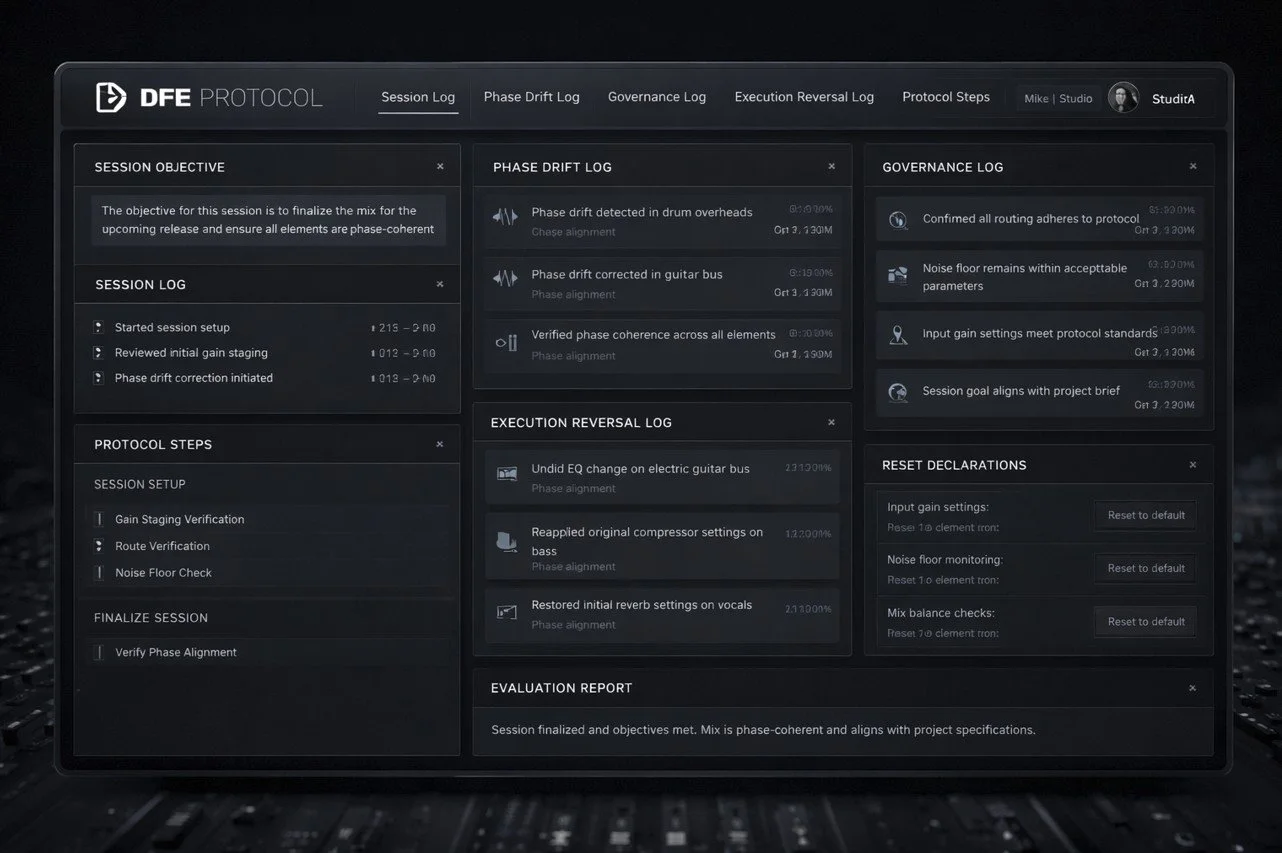
Introducing the First-Ever Session Governance OS for Recording Studios!
Stop losing time, money, and creative momentum to disorganized sessions. Our platform brings structure, accountability, and clarity to every project, from the first note to the final mix.
DFE is a formal operational system that engineers the decision environment inside complex creative workflows. It formalizes four structural elements that currently operate by instinct, habit, or accident in most studios:
Decision Sequencing
Defines the order in which creative and technical decisions are made and locks them sequentially — so downstream work never rests on an unstable foundation.
Authority Structure
Declares in advance who holds decision authority at each phase of a session — eliminating ambiguity before it becomes conflict.
Temporal Engineering
Structures session time around decision milestones, not activity blocks, so time spent in the room is always working toward a defined output.
Cognitive Load Containment
Limits the number of active variables at any decision point, protecting engineer focus and team confidence through long, complex sessions.
DFE does not replace your tools. It makes them work at their full potential by ensuring the people using them are operating inside a stable decision environment.
Appendices
Appendix A — Phase Boundary Summary
Appendix B — Drift Classification Overview