
Engineering Disciplines of the Recording Studio
Most discussions of audio engineering focus on sound, tools, and technique.
This body of work focuses on something else entirely.
Beneath microphones, consoles, software, and workflows exist a set of invisible systems that determine whether creative work advances or collapses. These systems govern how decisions are made, how time is experienced, and how judgment is exercised—often without the engineer realizing it.
The Engineering Disciplines of the Recording Studio publications identify and formalize these systems.
Each discipline addresses a distinct failure mode common to modern recording environments. They are not stylistic preferences, productivity tips, or workflow optimizations. They are engineering frameworks concerned with judgment under real creative pressure.
These disciplines are designed to stand independently, while remaining conceptually aligned.
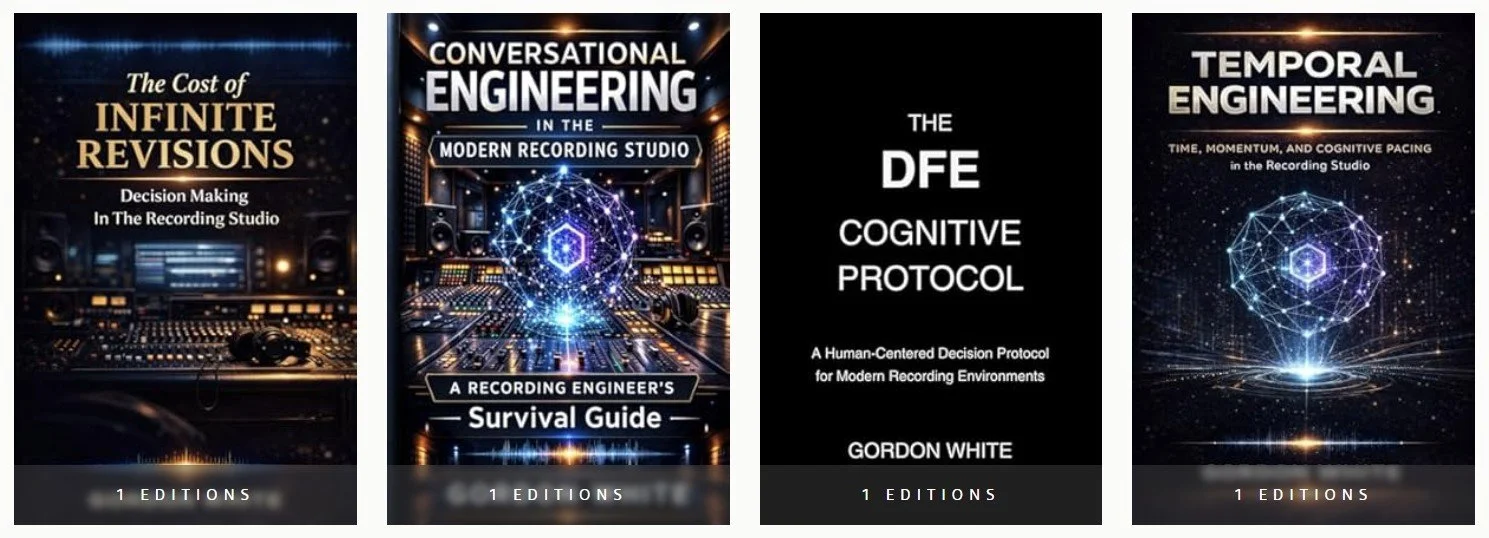
Discipline I — The Cost Of Infinite Decisions
This book is not about tools.
It is about the decisions that shape creative work long before results are judges, how judgment is framed, how responsibility is held, and how refinement either serves direction or quietly replaces it.
Across recording studios and other creative environments, familiar problems repeat: endless tweaking, circular listening, contested authority, unfinished work, and features that teach nothing. These problems are often treated as technical or personal. This book argues they are structural. They emerge not from lack of skill or effort, but from decisions made too late, or not made at all.
Through a series of focused chapters, the book examines how pressure alters judgment, why refinement can become a substitute for responsibility, how listening depends on orientation rather than neutrality, and why finishing requires authority rather than exhaustion. It does not offer techniques, workflows, or systems to adopt. Instead, it traces patterns that experienced practitioners already recognize, but rarely name.
Written for readers who already know how to work, this book assumes experience and respects judgment. Its purpose is not to instruct, but to clarify and make visible the sequences that quietly determine whether work stabilizes or drifts.
If tools have not solved the problem, the problem may not be technical.
It may be when decisions are made.
Available on Amazon. 12.99
https://read.amazon.com/sample/B0GKJ3WVZG?clientId=share
Discipline II — Temporal Engineering
Temporal Engineering addresses how time is experienced, protected, and mismanaged during recording sessions.
Sessions do not collapse solely because something goes wrong. They collapse when momentum is interrupted, cognitive energy is misplaced, or the timing of intervention is incorrect. Fixing the right problem at the wrong moment can be as destructive as fixing the wrong problem entirely.
Temporal Engineering treats time as an engineered variable—not a neutral backdrop.
It governs when actions occur, and how creative energy is preserved or destroyed across a session.
Available on Amazon. 19.99
https://read.amazon.com/sample/B0GLGPRFZR?clientId=share
Discipline III — Conversational Engineering
Conversational Engineering examines how engineers interact with intelligent systems inside the studio, particularly AI-assisted tools, and how judgment is shaped, diluted, or transferred through those interactions.
As conversational interfaces become embedded in creative workflows, engineers increasingly think through machines. Poorly constructed prompts, ambiguous instruction, and over-delegation can quietly replace human judgment with automated inference.
Conversational Engineering treats dialogue itself as an engineered interface.
It governs how intent is translated into instruction, and how authorship is preserved in AI-augmented environments.
Available on Amazon 9.99
https://read.amazon.com/sample/B0GKVF5TQ2?clientId=share
Discipline IV - The DFE Cognitive Protocol
Modern recording environments offer unlimited flexibility.
Unlimited flexibility creates unlimited reconsideration.
Most sessions do not fail because of poor sound.
They drift because decisions are never structurally governed.
The DFE Cognitive Protocol introduces a phase-based decision architecture designed for contemporary music production.
Instead of reacting to tools, plugins, and constant comparison, DFE restores sequence:
DEFINE before manipulation
EVALUATE with boundaries
EXECUTE with containment
FINISH with declaration
Through applied examples, real studio scenarios, and behavioral insight, this compact manual explains why engineers over-compare, why execution destabilizes mid-session, and why completion is often avoided.
DFE does not replace creativity.
It protects it.
As digital systems expand and AI accelerates production workflows, engineers require more than better tools. They require structural clarity.
This book introduces the discipline layer serious rooms adopt.
If you’ve ever felt a session slowly lose direction, this professionally written manual names why.
And shows how to stop it.
Available on Amazon 24.99
A Living Framework
These disciplines are not exhaustive.
They represent an evolving effort to identify and articulate the underlying systems that govern creative work in the recording studio—beyond sound, beyond gear, and beyond technique.
Each discipline may be studied independently. Together, they form a coherent framework for understanding modern engineering practice at its deepest level.
Coming Soon: The Decision Station
Reference Object · Edition I
Product Abstract
The Decision Station is a fixed reference object designed to live permanently at the console.
It brings listening, thinking, and committing into the same physical space.
It holds exactly what is required for serious work—and nothing more:
a single pair of headphones, two core texts, a writing instrument, and a place for the phone to exist without dominating attention.
Why This Exists
Modern studios suffer less from a lack of tools than from an excess of choice.
The Decision Station was created to make the act of deciding visible—and unavoidable.
This object does not organize gear.
It organizes judgment.
Issued as a complete system.
What Is Included
Integrated headphone support.
Dual-volume cradle intended for placement of “The Cost of Infinite Revisions”, “Conversational Engineering”, and other upcoming publications from Gordon White (hint, hint)
Pen and pencil tray.
Upright phone boundary stand.
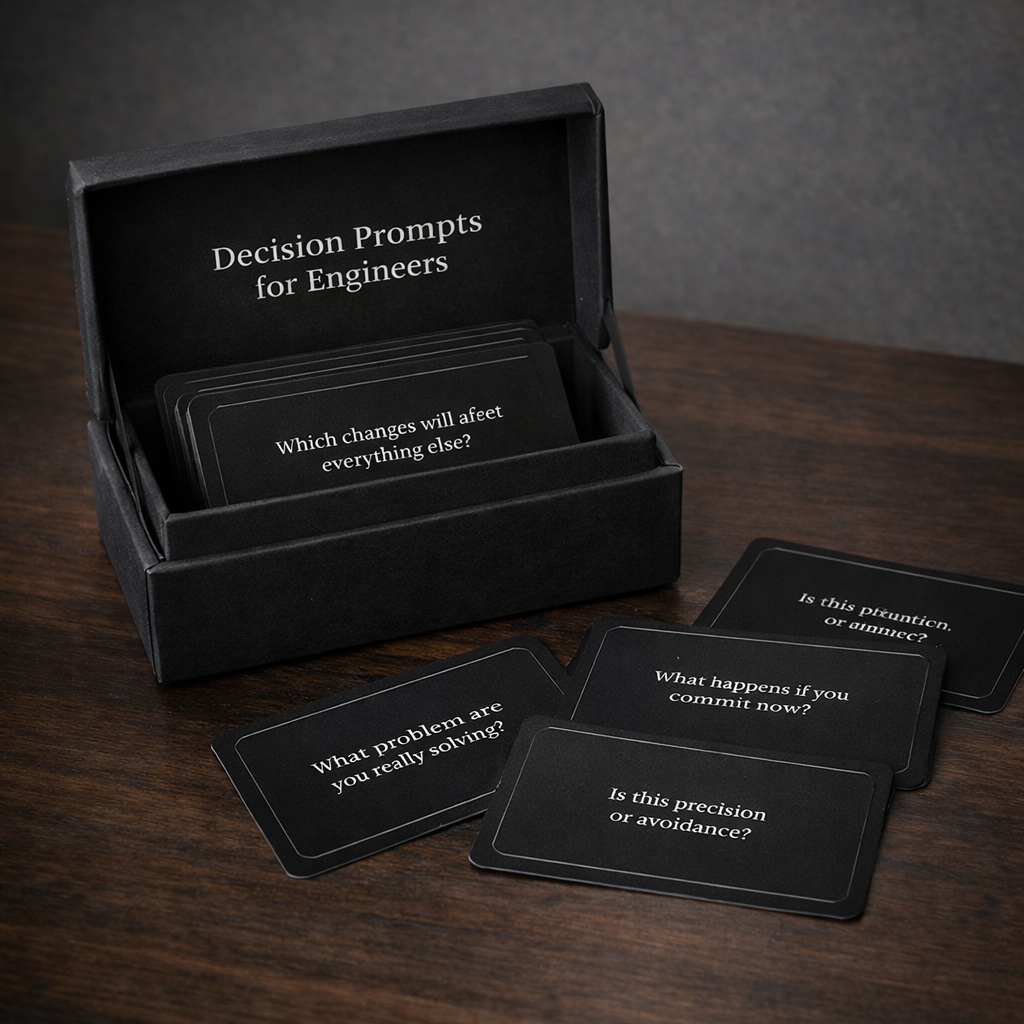
Session Commitment Deck (24 cards).
They’re pulled only when:
The engineer is looping
Options are multiplying
Confidence is eroding
A neutral third parties challenge (the Decision First Engineering system) is required
All components are permanently integrated.
Nothing is modular.
Nothing is optional.
Issuance
Edition I · 300 units
Produced once.
This edition will close when issued.
Availability: Spring 2026
Issued Price
445 USD
Domestic shipping included